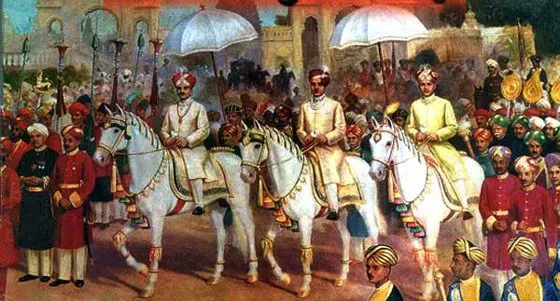
Four centuries
History of Mysuru Dasara
Four hundred years of the Nada Habba — from Vijayanagara to the present day.
Mysuru Dasara marks the victory of Goddess Chamundeshwari over the demon Mahishasura. The State of Karnataka observes it as its Nada Habba, the festival of the land. Its present form is the result of more than four hundred years of continuous royal and, later, civic observance.
Roots in the Vijayanagara Mahanavami
The festival draws on the Mahanavami celebrations of the Vijayanagara Empire. At Hampi, the rulers observed nine nights of ceremony that ended in a public display of the army, elephants, wrestling and fireworks. Accounts left by visitors in the fifteenth and sixteenth centuries describe these festivities in detail. After the empire declined in 1565, several of its former feudatories continued the observance in their own territories. The Wadiyars of Mysuru were among them.
Observance under the Wadiyar dynasty
- 1610: Raja Wadiyar I conducted the festival at Srirangapatna. This is regarded as the beginning of the Mysuru tradition.
- Nineteenth century: Krishnaraja Wadiyar III gave the celebration its characteristic form in the city of Mysuru, including the royal Durbar.
- Early twentieth century: Krishnaraja Wadiyar IV expanded it into a public festival with exhibitions, sporting events, illumination and a procession open to all citizens.
The Wadiyar family continues to hold the private Durbar at the Palace during Sharannavaratri.
A festival of the State
Since the 1970s the Government of Karnataka has organised Dasara as the State festival, and the Mysuru District Administration conducts it. In the procession, the idol of Goddess Chamundeshwari now takes the place once occupied by the Maharaja. It is carried in the golden howdah on the lead elephant from the Palace to Bannimantap on Vijayadashami.
Today the festival comprises more than a hundred programmes, including:
- cultural performances at venues across the city
- Yuva Dasara, Raitha Dasara, and Mahila & Makkala Dasara
- the Aahara Mela and the Fruit & Flower Show
- literary, sporting and heritage events
- the Dasara Exhibition
- the Jumboo Savari and the Panjina Kavayathu (Torchlight Parade) on the final day
Timeline
| Year | Event |
|---|---|
| 1336 | Founding of the Vijayanagara Empire. The Mahanavami observance at Hampi becomes the model for later Dasara celebrations. |
| 1565 | Decline of Vijayanagara; its feudatories carry the tradition forward. |
| 1610 | Raja Wadiyar I conducts the festival at Srirangapatna. |
| 1799 | The Wadiyars are restored to the throne of Mysuru, and the Dasara Durbar continues. |
| 1805 | The celebration opens to the public under Krishnaraja Wadiyar III. |
| 1912 | Completion of the present Amba Vilas Palace, whose illumination becomes the defining image of the festival. |
| 1970s | Dasara is organised by the State Government as the Nada Habba. |
| 2010 | The four-hundredth year of the festival is commemorated. |
| 2026 | Mysuru Dasara is observed from 11 to 21 October. |
Last updated on 24 September 2026